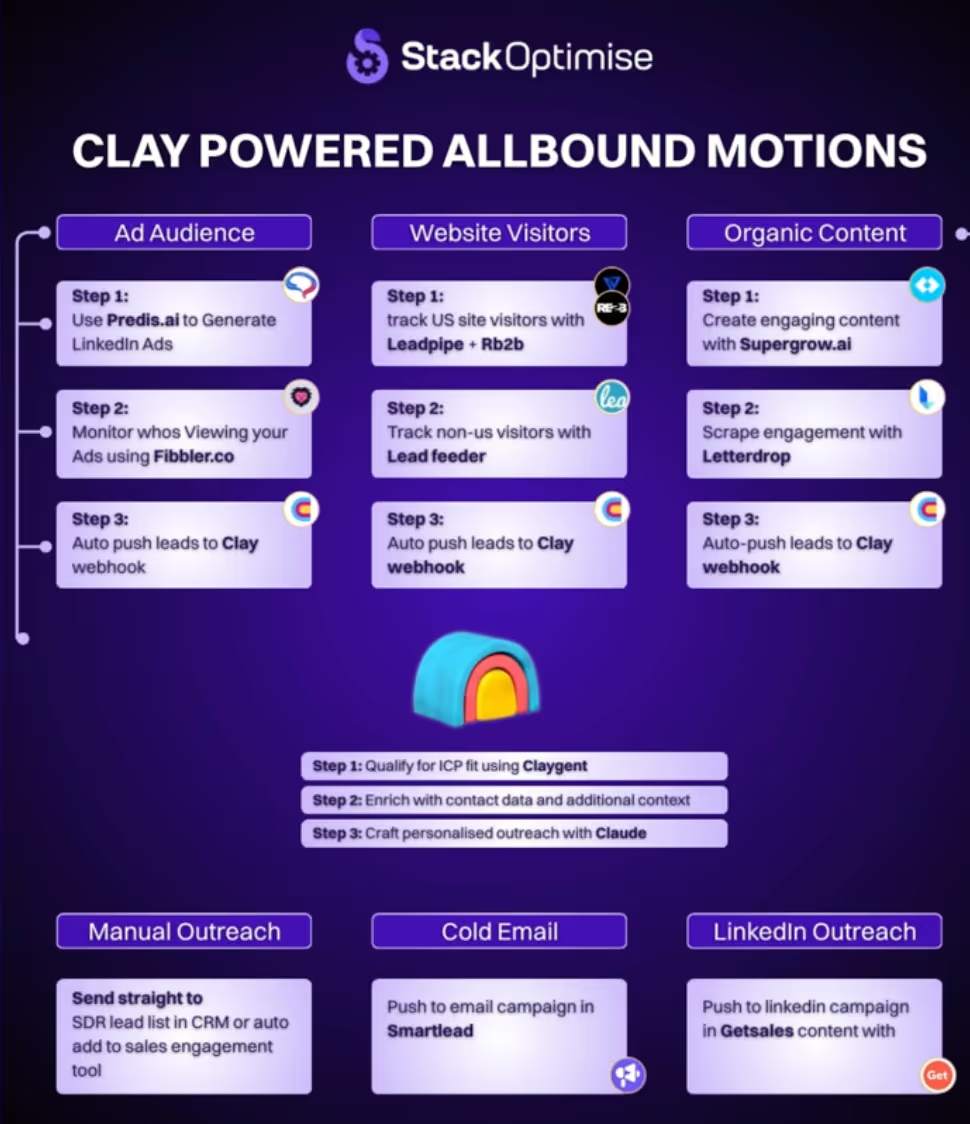
Claim your free Custom outbound action plan
White check mark inside a green rounded square button.
Success! Your custom action plan will be emailed in 5 mins
Oops! Something went wrong while submitting the form.
Transparent eyeglasses with thin black frames and a subtle purple reflection on the lenses.
The best GTM content from across the internet - curated daily, all in one place.
GTM News Feed
2.8K Posts
Share GTM News Feed
Bookmark The Feed
Newsletter
Go-to weekly newsletter for GTM operators, packed with actionable tutorials, tools, tips, templates, and free resources you can use immediately.
Top Contributors
Felix Frank
Penn Frank
Petr Kaliuzhny
Tyce Hilton
Nick Abraham
Eric Nowoslawski
Patrick Spychalski
Brigitta Ruha
Alan Ruchtein
Can Timağur
Nick Palasz
Adam Robinson
Tim Yakubson
Josh Whitfield
Alex Fine
Varun Anand
Harris Kenny
Kellen Casebeer
Michael Saruggia
🤖 Jacob Tuwiner
Brandon Charleson
Christian Oland
Matthew Putnam
Arnaud Belinga
Enzo Carasso
Abbas Somji
Mohan Muthoo
Yurii Veremchuk
Aaron Reeves
Hans Dekker
Nolan Ong
Thomas Nagy
Muhammad Rafay
Mark Timothy Agarrado
Done Miladinov
Stefan Mrvic
Load More...
Follow StackOptimise
Brandon Charleson
January 18, 2026 3:02 AM
Why MCP + Chat Apps Are About to Redefine SaaS
SaaS Shift: Partnerships, MCP, and ChatGPT Integration
If you haven't already noticed, there are two major things happening in SaaS (and any software) really... 1️⃣ There is a huge shift in how SaaS platforms of all types are figuring out how to partner and collaborate more. Even competitors like Instantly.ai, Lemlist, and Smartlead are integrated with each other. The next MAJOR movement that has recently creating even more buzz is MCP (Model Context Protocol) -- aka "Connectors" are now more enriched than ever. MCP now has beautiful front-end and interactive user interface WITHIN the chat apps like ChatGPT. ChatGPT just released their Apps SDK which means you can connect with other "micro-apps" within the chat window. This is so much more than standard text responses because it literally means you can do effectively anything via a chat UI and interact with the application. THIS right here, my friends....sets the stage by far on how SaaS applications are even built. For any SaaS Founders/CEOs, here are some things I would ask and challenge you on three questions: 1️⃣ - When you or your sales team acquire customers, do you require people to 'login' to your platform, you're essentially bringing another Bookmark or "Home" to the user. Ask yourself, "does my customer REALLY need to interact with a manual frontend"? 2️⃣ - Do you have an open API already? If so...do you have an MCP already in play? Here's why → MCP is more/less built on top of API. OpenAI's App SDK is also built on MCP where the endpoints and tools are exposed. There are exceptions to this, but this is where it's going. 3️⃣ - For any ICP or customer (or all of us really), it's all coming back to simple chat apps using natural language to get the job done. If you're ever in a moment where productivity and time management is top of mind... Ask yourself...for every single platform, every single "click", every single step you do in any workflow, is there a better way on what is possible now-a-days? Only you can answer that (and it's right before our eyes). 🍻
Linkedin.com
🤖 Jacob Tuwiner
January 18, 2026 2:57 AM
I Tested Clay’s Sculptor So You Don’t Have To
Clay Sculptor Review: AI Table Builder Performance
I tested Clay’s new Sculptor feature (their AI table builder) that claims to build Clay tables end-to-end from natural language prompts. Using a very detailed, production-level prompt, I asked Sculptor to create a full table with: - Company import (name, domain, record ID) - LinkedIn company matching + employee counts - Revenue range (waterfall enrichment) - Marketing headcount - Company HQ address in structured JSON format - AI-generated company summary (Claygent) - GPT-based industry classification from the summary It took me over 11 minutes and I experienced several bugs along the way. Here are my findings: 1️⃣ Sculptor missed several important enrichments from my prompt. Despite sharing a robust prompt (see in the video below), both the claygent summary and gpt industry enrichment were left out. I had to manually prompt Sculptor again for the additional properties. Unfortunately, the dream to "just tell Clay what I want and voila, it's magically built" isn't yet a reality. If this became a reality, building with Clay would be STUPID easy. 2️⃣ No conditional formulas were built, nor were any default settings changed These are two "must haves" when building Clay tables. Overall, I didn't find the Sculptor experience to be amazing or a game changer. 3️⃣ Sculptor still takes a while I'm assuming Sculptor uses a complex reasoning model, hence the wait times... but I had to wait a fair amount of time for my prompts to process. I kept thinking it'd be faster if I just built the columns myself. However, Sculptor is quite helpful for these two specific use cases: 🎛️ Complex formula columns Sculptor is MUCH easier to use for complex formula building than the legacy AI formula builder. I use it all the time for this when the AI formula builder isn't working. 📈 Understand & act on your data, fast This language is pulled directly from clay(dot)com/sculptor and I think it's the "truest" value proposition on the landing page. Asking for specific metrics about the table, such % row completion, and other information about the dataset is quite helpful. At this point, I use Sculptor as an analytics tool, not a table builder... Overall, is Sculptor going to save you tons of time on your Clay tables? TBD. I made a follow-up video where I built the exact same table manually to see if I could beat my time with Sculptor. Stay tuned!
Linkedin.com
Eric Nowoslawski
January 18, 2026 2:27 AM
How We Let LLMs Build Our Google Maps Lead Engine
Here's the prompt to get you started building your own google maps scraper with Claude code or Cursor. One of my favorite things about LLMs and coding is that my team can build things that impact…
Here's the prompt to get you started building your own google maps scraper with Claude code or Cursor. One of my favorite things about LLMs and coding is that my team can build things that impact our business and then everyone can use. Bharatt Arorah built this google maps scraper for us and it's been so easy to use. Then when someone else on the team wants to add to it, it'd be really easy for them. This scraper is built on a RapidAPI endpoint that gives us 3,000,000 requests per month for $100 a month. Here's the prompt I'd give for Cursor or Claude Code to figure this out for you. First connect to the Rapid API MCP and then run this because it'll ask you to restart. (I don't use the MCP to actually run the code. I just use it to connect to the documentation to help set everything up). If you need the list of zip codes don't ask me or your mother for it. Ask Chat GPT literally asking "Do you know of any GitHub repositories that have all of the zip codes in the United States, or any other public ways that you can download that information easily?" and it'll come up, I promise. Long Text not optimized for a linkedin post AT ALL. Hey cursor, can you explore this Google Maps endpoint and build a plan for me that would be able to create an input where I can say a Google category, and then you'd be able to scrape it? Here is a file of all the zip codes around the United States so that you have something to parse by. Search every one of these zip codes with my keyword to then find the companies that are in those areas. Build something into it that includes logic that, if a company is in a different business category that is excluded from my results, I want to be able to filter for the category. Let me know if we could exclude the cities and also run multiple category searches in one run. Set up the database schema to pull the zip codes from SupaBase. Literally go one by one doing a search across each of the zip codes. I also might wanna specify that I want to include certain cities, exclude certain cities, or include and exclude states in the future as well. Let's also add the filters for that to be possible as well. Hope that helps and provides a good lead gen project for people trying to get into coding with Cursor or Claude code. Send those companies over to a Clay webhook to have a contact finding waterfall and you're all set! | 15 comments on LinkedIn
Linkedin.com
Nick Palasz
January 16, 2026 6:17 AM
5 Checks Before Your Cold Email Campaign Goes Live
5 pre launch checks for your next cold email campaign
5 pre launch checks for your next cold email campaign If you are sending emails without any safety measures… this is for you I’ve experienced lots of issues while running email campaigns including - Domains getting flagged - Replies are stuck - Campaigns burning out in 2 weeks Everything would be decent, but the setup? Completely overlooked. So I worked on some safety measures Here they are… 1. Infrastructure Check Make sure you're not using your primary domain, Gmail workspaces, or random SMTP boxes. One mistake and your main brand email is done. You need dedicated mailboxes built for outbound. Maildoso helped me with it 2. Domain + DNS Check Verify DNS propagation, correct records, no blacklists, and zero abuse history before sending Because anti spam systems are watching from day one 3. Volume & Ramp Check Start at 10 emails per mailbox on day 1, then slowly increase them Sending a massive volume can trigger spam filters 4. Targeting & Relevance Check Confirm you're emailing the right ICP with messaging that actually fits their world. Deliverability means nothing if you're hitting the wrong person. 5. Sequence & CTA Check Keep your CTA simple, don't pitch in email #1, and format for mobile readability. People like to skim emails. Cold email isn't complicated but it does require respect for the basics Let Maildoso handle the infrastructure and make sure your campaign setup doesn't damage what the tech is built to protect Run these checks, then hit send with confidence | 42 comments on LinkedIn
Linkedin.com
Felix Frank
January 16, 2026 1:48 AM
2025 GTM Tool Ranking
Most GTM teams are bloated with tools they don’t actually need.
Most GTM teams are bloated with tools they don’t actually need. Here’s how I’d rank the stack going into 2025: Must-Have: Tools that give you leverage, scale, and speed. You’ll feel the pain the second you stop using them. → Smartlead - best-in-class email deliverability at scale → GetSales.io - Handle all your LinkedIn outreach in one place → HubSpot - clean CRM that just works → Clay - unmatched data enrichment + personalization workflows → AI Ark – the only prospecting database you need Nice-to-Have: Helpful, not essential. They can boost your ops, but don’t build your whole system around them. → Trigify.io - social signals for outbound timing → CommonRoom - community intel + complete signals platform → Ocean.io - decent for ICP research → UserGems 💎 - warm outbound via job changes → Leadfeeder - uncover your website visitors (less useful than it sounds) Overrated: Either overpriced, overhyped, or simply outperformed. They had their moment but the game has changed. → Apollo - data quality still patchy at scale → 6sense - great in theory, clunky in execution → Cognism - expensive for what you get → ZoomInfo - outdated workflows, inflated cost → Outreach - will burn your domain The best GTM stacks are lean, fast, and ROI-driven. You don’t need more tools. You need the right ones. What would you add or remove from this list? StackOptimise ⚙️ | 18 comments on LinkedIn
Linkedin.com
Alan Ruchtein
January 15, 2026 12:28 AM
2026 outbound hack: AI SDRs that actually get meetings.
Here’s the truth no one tells you about AI AGENTS in 2026 and you must know before it’s too late:
Here’s the truth no one tells you about AI AGENTS in 2026 and you must know before it’s too late: Most teams talk about “AI SDRs” like it’s some futuristic thing. It’s not. It’s just the new way top outbound teams already operate in 2026. If you want an AI SDR that actually books meetings and not just another bot sending spam, follow the exact blueprint I use with my clients 👇 1️⃣ Map the SDR workflow Before you automate anything, break the job into small stuff This includes researching accounts, spotting triggers, writing emails, personalizing, qualifying inbound, following up, and updating the CRM. If you don’t know what the AI should own, nothing will work. 2️⃣ Assign each responsibility to its own AI agent Think of it like building a tiny GTM team: • CRM Agent • Inbox Agent • Writer Agent • Trigger Agent • Research Agent • Sequencer Agent Each one handles a specific part of the process so nothing gets dropped. 3️⃣ Train the AI to think like your best SDR Give it a persona, feed it your ICP pains, your POVs, your proof. Let it write the emails, the call scripts, the follow-ups, the objection handling. Save your best prompts somewhere and reuse them. Don't start from scratch every time. 4️⃣ Turn the whole thing on A signal fires, research happens instantly, a fresh POV gets created, the message goes out, follow-ups happen automatically, CRM gets updated, and managers get notified when something matters. No lag. No guessing. No “I forgot.” 5️⃣ Track everything and refine it Open rate, reply rate, positive replies, meetings booked, time-to-first-touch. Every cycle makes the system smarter. Modern AI AGENTS don’t replace reps. They replace everything that slows reps down. Follow Alan Ruchtein for more AI-native outbound playbooks and the exact workflows that will separate the leaders from everyone else in 2026
Linkedin.com
Abbas Somji
January 14, 2026 11:15 PM
15 Tools to turn your Linkedin profile into a Lead Machine
15 LinkedIn Tools for Lead Generation | Abbas Somji👋🏽 posted on the topic | LinkedIn
15 tools to turn your LinkedIn profile into a lead machine Everyone's asking the same question: "Abbas, which LinkedIn tool should I use?" Wrong question The question isn't which tool, it's which layers I'm going to make this stupid simple 👇🏿 Here are the 15 tools we've actually used organised by layer because that's what matters Layer 1: Clean Data Prospeo.io, Apollo, Cognism, Wiza, Lusha These tools will allow you to pull lists directly from Sales Navigator via extension + give you the emails + mobiles for multi-channel outreach Layer 2: Automation Infrastructure HeyReach, lemlist, La Growth Machine, PhantomBuster, Dripify, Expandi Pick 1, don't overthink it HeyReach.io the safest, lemlist the most balanced, La Growth Machine has some great features like automated voice notes, PhantomBuster is most powerful Layer 3: Intent Detection Trigify, Clay, Teamfluence 󠁯•󠁏󠁏 Trigify.io tells you when they're buying - Social Listening Data 󠁯•󠁏󠁏 Clay ties everything together - Your data warehouse for signal stacking 󠁯•󠁏󠁏 Teamfluence™ shows profile visitor data (The hidden one most teams miss) The math: Clean data + Right automation + Perfect timing = 800+ conversations monthly 🚀 You don't need the best tool, you need the right layers What else am I missing? Seems to be a new tool every week - but these are the most reliable I've used so far. __________________ If you need help turning your LinkedIn profile into revenue - I run The Playbook Agency (A content + Data Agency that gets you in front of buyers) | 25 comments on LinkedIn
Linkedin.com
Enzo Carasso
January 14, 2026 11:10 PM
Why most outbound fails: relevance first, personalization second.
Most teams suck at outbound. And there's one mistake that trips them up: Teams push messages out quickly, across broad lists, without a real offer behind them. It feels efficient because activity…
Most teams suck at outbound. And there's one mistake that trips them up: Teams push messages out quickly, across broad lists, without a real offer behind them. It feels efficient because activity ramps up fast. That decision leads to the first failure mode. 1/ Low relevance, low personalization Generic messaging goes to loosely defined audiences (backed by weak ICP logic and unclear value). The result is predictable. - Reply rates stay low - Spam complaints increase - Domains decay before pipeline appears At this point, teams conclude outbound itself is broken. So they try to fix it. 2/ High personalization, low relevance Instead of changing the offer or the ICP, they add effort. They personalize everything. - Data points - Custom openers - Personal trivia Replies improve, which feels like progress. But meetings don’t qualify. Pipeline doesn’t move. Personalization increases activity, not relevance. The conversation starts, but there’s still no business reason to continue it. Eventually, the real issue becomes obvious. 3/ Low personalization, high relevance When outbound works, it starts with clarity, not cleverness. - A strong ICP definition - Clear economic pain - Role-specific framing - A repeatable offer Because relevance is doing the work, messages can stay simple. Signal improves. Volume starts compounding instead of hurting. This is where outbound becomes predictable and scalable. Some teams then push it further. 4/ High personalization, high relevance For priority accounts, they add depth. - Deep account research - Custom pain framing - Tailored offers Conversion rates climb. So does cost. This approach also means: - Manual workflows - High effort per touch - Limited scalability This works when used intentionally. It breaks when treated as a default motion. After seeing this cycle enough times, the pattern is clear. Outbound doesn’t fail because teams don’t personalize enough. It fails because they personalize before relevance is established. Relevance has to be engineered first. Personalization should come after, and only where it pays. Most teams reverse that order and absorb the cost. Where does your outbound sit today? Share below. Want to see how C17 Lab runs outbound built to actually convert? Start with a no-cost pilot campaign. Apply here: https://bit.ly/C17Pilot Repost this for someone still confusing personalization with relevance. Follow Enzo Carasso 🧲 for more on outbound, offer creation, and GTM execution.
Matthew Putnam
January 14, 2026 10:58 PM
7 Cold Call openers that get prospects talking
7 Cold Call Openers to Get Prospects Talking
7 cold call openers that get prospects talking And they’re simple as f***: 1. Permission-based “Hey [Name], it’s [You] from [Company]. I know I’m calling out of the blue. Can I take 30 seconds to share why I called, and you can tell me if it’s relevant?” 2. Honest cold call “Hey [Name], quick heads up, this is a cold call. Before you decide to hang up, can I tell you why I’m calling? If it’s not relevant, I’ll let you go.” 3. Inject some Humour “Hey [Name], it’s [You]. I’m cold calling on a Monday morning, so I’ll keep this short. Can I give you the quick version?” Or steal some of that Giulio Magic 4. Direct pitch “Hi [Name], [You] from [Company]. We’ve helped teams like yours improve [specific metric] by [X%] in [timeframe]. Worth 30 seconds to see if that’s even on your radar?” 5. Mutual connection “Hi [Name], it’s [You]. I was speaking with [Mutual Connection] and they suggested I reach out about [topic]. Do you have a minute for a quick question?” 6. Current event “Hey [Name], [You] from [Company]. With the recent changes in[trend/regulation], I wanted to flag something we’re seeing.Can I share it quickly and get your take?” 7. Problem-centric “Hi [Name], [You] here. I’ve been talking to a lot of [job titles] in [industry], and [common problem] keeps coming up. Is that something you’re running into too?” If you only take one thing from this: Ask for a small yes first. Then earn the next minute. Which opener style works best for you?
Linkedin.com
Nick Palasz
January 14, 2026 9:52 PM
3 Simple AI Workflows That Fix Broken Outbound
Boosting Outbound Efficiency with AI Workflows
It’s the start of 2026, and a lot of teams expect outbound to feel different New tools New AI Fresh dashboards But for many, it already feels familiar Replies are inconsistent Pipelines spike then disappear Good weeks don’t repeat That usually points to one thing The system hasn’t changed AI makes sending faster but the work before sending is still messy -Lists still have bad data -Reps still guess who matters -Messages still go out at the wrong time Here are 3 AI workflows that quietly fix broken outbound 1. Clean → Score → Send Clean the list and remove dead emails, job changes, wrong roles and only reach out when someone actually looks ready Example Prompt: “Clean this list, remove invalid emails, detect job changes, and score each contact 1–10 based on intent signals. Return only the top 20% highest-signal prospects.” 2. Rewrite → Compare → Improve Generate a few angles instead of one “good” email and keep the version people reply to Example Prompt: “Rewrite this cold email in 5 variations: shorter, direct, conversational, trigger-based, and CTA-focused. Then explain which variation has the strongest clarity and relevance.” 3. Predict → Prioritize → Personalize Surface who’s most likely to respond, then personalize using real movement instead of fillers Example Prompt: “Identify which prospects show the strongest buying signals and create one personalized opening line for each based on their recent activity or role change.” New year energy only goes so far if the system stays the same P.S. What’s the first thing you’re cleaning up in 2026?
Linkedin.com
Penn Frank
January 14, 2026 8:03 PM
Cold Email Vs. LinkedIn Outreach
Cold email and LinkedIn DMs serve the same goal - but they work in slightly different ways. We’ve run thousands of both everyday, and here’s what we’ve learned 👇 1️⃣ Copy Cold emails need to sound…
Cold email and LinkedIn DMs serve the same goal - but they work in slightly different ways. We’ve run thousands of both everyday, and here’s what we’ve learned 👇 1️⃣ Copy Cold emails need to sound professional and stripped down. LinkedIn DMs work best when they sound like something you’d actually say. 2️⃣ Volume Cold email = scale. 20–30/inbox/day. LinkedIn = slower pace. Around 200 new connections/week/profile. 3️⃣ Rules Email success comes from relevance and proof - direct, simple, and credible. LinkedIn success comes from consistency - showing up, commenting, and sharing useful content. 4️⃣ Follow-up Email: 3-5 value-led touchpoints. No empty followups. LinkedIn: max 3 messages, spaced out, keep it social. 5️⃣ Tools & Testing Email: test multiple versions - value, case study, pain question. LinkedIn: test different DMs at scale, double down on what gets replies. 6️⃣ Results & Setup Cold email: higher volume, lower reply rate, easy to scale. LinkedIn: smaller volume, higher engagement, harder to scale. Both channels work - but for different reasons. Email is the engine. LinkedIn is the accelerator. The best outbound strategies use both — working together, not competing. Learn how to leverage both at scale in 2025: https://lnkd.in/eN7qinfB | 54 comments on LinkedIn
Linkedin.com
GTM News Feed
2.8K Posts
Share GTM News Feed
Bookmark The Feed
Newsletter
Go-to weekly newsletter for GTM operators, packed with actionable tutorials, tools, tips, templates, and free resources you can use immediately.
Top Contributors
Felix Frank
Penn Frank
Petr Kaliuzhny
Tyce Hilton
Nick Abraham
Eric Nowoslawski
Patrick Spychalski
Brigitta Ruha
Alan Ruchtein
Can Timağur
Nick Palasz
Adam Robinson
Tim Yakubson
Josh Whitfield
Alex Fine
Varun Anand
Harris Kenny
Kellen Casebeer
Michael Saruggia
🤖 Jacob Tuwiner
Brandon Charleson
Christian Oland
Matthew Putnam
Arnaud Belinga
Enzo Carasso
Abbas Somji
Mohan Muthoo
Yurii Veremchuk
Aaron Reeves
Hans Dekker
Nolan Ong
Thomas Nagy
Muhammad Rafay
Mark Timothy Agarrado
Done Miladinov
Stefan Mrvic
Load More...